
granny

Earlier this week, I gave a presentation on genealogy for beginner's. I stressed that the hobby of genealogy can be challenging and frustrating, but also very rewarding and gratifying. This post reflects that sentiment and is dedicated to my great-grandmother, whose birthday was today, July 12, 1895.
Growing up, my Dad always told me about a woman he simply called "Granny." It was clear by the way he spoke that she was someone he loved dearly. Although grandparents shouldn't have favorites, apparently, my great-grandmother made no attempt to hide her favoritism toward my father. That could explain why they had such a strong bond and why my dad had such fond memories of her.
Once I started doing genealogy research, I started to learn more about her. Granny was born Bessie Hadacek to Jan (John) and Pauline Hadacek who had immigrated to the United States from Czechoslovakia in 1884. Jan, whose name was later Anglicized to John, and his wife Pauline came to America with three of their children: Jan, Antonia, and Josef. They later had three more children: Bohumil, Otto, and Bessie.
Bessie was born in Chicago in 1895. The family had settled there sometime after their arrival in the States. They arrived in the Port of Baltimore and made their way west. I am unsure what exact year they came to Chicago, but it is fair to assume they were there for a while. They would have lived in the Windy City during the World's Fair of 1893 and in a more macabre moment of history, also during the murders of H.H. Holmes, one of America's most well-known serial killers.
Although I do not know exactly what Bessie's father did to earn money for the family, it's safe to say that they were not poor. The trip to America alone would have cost money, but then to be able to travel west and settle in Chicago would also not have been cheap. My family also has turn-of-the-century photos of the family that hint toward at least a moderate measure of wealth.

My father remembered his mother and grandmother talk about their time in Chicago. Communities within inner cities were structured then similar to how they are today. Each cultural group had their own sets of blocks. The Irish had one neighborhood, the Polish had another, the Czechs had another. Most people in those communities never ventured outside of their streets. They had their own groceries and businesses. They spoke their native languages. The cultural communities were very insular. It was not until my grandmother (Dad's mom) attempted to attend school in the late 1920s that she learned English, and that was only because the teacher sent her home until she could speak English.
In 1915, Bessie married another Czech whose family immigrated to America around the same time as the Hadaceks. Bohumil Pitra went by the name Bo, and according to Dad's conversations with Granny, he was a jovial man. He owned a contracting business. He learned the trade from his father, Frank Pitra, whose name is mentioned a lot in the Chicago Tribune for applying for permits for various building projects throughout the city between 1912 and 1919. I've looked up several of the addresses that were listed in the paper and some of them are still standing. It's crazy to think that my ancestor played a role in the development of modern Chicago and that some of the buildings are still there.

My grandmother, Sherlene Pitra, was born June 2, 1922. Sherlene was adopted, although she never knew that until she turned 62 and was applying for social security. Unfortunately, her mother was long gone by that point and she couldn't ask any questions. Most adoptions in that era would have been private and stayed between families. Maybe her parents got sick and died, or were otherwise unable to care for her, and Bessie and Bo agreed to take her in. Whatever the situation, I have been unable to find paperwork that confirms Sherlene's biological family. Despite being adopted, Bo and Sherlene formed a very close bond. She was a Daddy's Girl through and through, according to Bessie.
But mother and daughter were also very close. When the stock market crashed in 1929, Bo's business suffered greatly and his health took a toll from the stress. He died of a heart attack in 1933 at the age of 45, leaving Bessie and Sherlene alone.
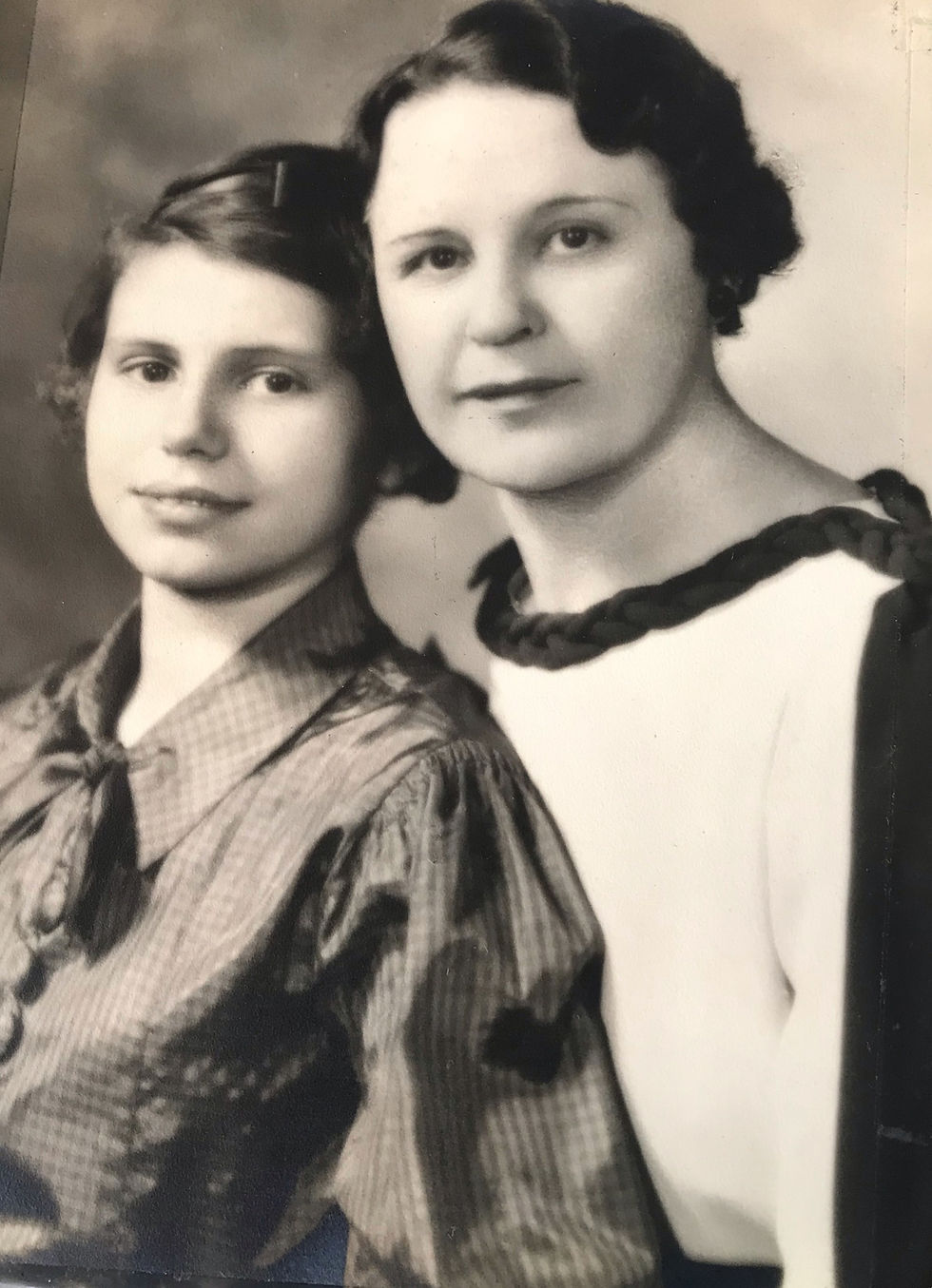
Some time after Bo passed away, the mother-daughter duo moved to Washington D.C. This was where Sherlene would meet and marry widower Frank Kennedy in 1950. My dad and his brothers were born in 1950, 1951, and 1952. My father grew up with stories about his Granny's childhood and fond memories of shopping with her in D.C. Bessie Hadacek Pitra died in 1972 and was buried in Broome's Island, Maryland. I have only been to her burial site once and that was when my family traveled to Maryland for my grandfather's funeral in January 2022. Dad was able to show me and my sister (Sherlene, named after Dad's mom) where Granny was buried. This ended up being a special moment because I would never travel to Maryland with my dad again. He passed away later that same year.

I'm grateful for the time I got to spend with my Daddy and the stories he told me about his Granny. Although I didn't learn about the details of her life until I was older and did my own research, I feel like I knew her through his stories and memories.
Thank you for caring.


Comments